
cosmeticsurgery@umassmemorial.org Contact us today to schedule a no-obligation consultation.

Cosmetic Procedures

Eyelid surgery (blepharoplasty)

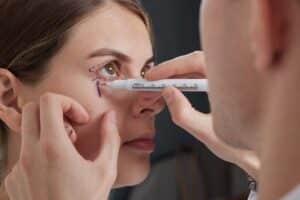
Eyelid surgery, also known as blepharoplasty, is a procedure to remove excess skin and fat tissue from the eye area.

Reasons for procedureback to top

Blepharoplasty can correct:

  • Drooping upper eyelids
  • Excess skin of the lower eyelids
  • Puffiness of the upper or lower eyelids

This procedure can also create upper eyelid folds.

What to expectback to top

Prior to procedure. Your doctor will likely do the following:

  • Physical exam
  • Vision tests
  • Examination of the eyelid and supporting structures

Leading up to your procedure, your doctor may recommend that you:

  • Follow a special diet
  • Take certain medicines
  • Arrange to have someone drive you home, as well as arrange for someone to help you at home

Talk to your doctor about your medicines. You may be asked to stop taking some medicines (including herbal supplements) up to one week before the procedure, like:

  • Aspirin or other anti-inflammatory drugs
  • Blood thinners, such as clopidogrel (Plavix) or warfarin (Coumadin)

Anesthesia. You will be given a local anesthetic to numb the area around your eyes. Sedatives will be given to help you relax. In some cases, general anesthesia will be used. In this case, you will be asleep.

Description of the procedure. Your doctor will make incisions in your eyelids. In the upper eyelid, the incision is usually made in the crease. In the lower eyelid, the incision is usually made either just below the lashes or on the inside of the eyelid. The excess fat will be removed. The excess skin and muscle will be trimmed. The incision will be closed with sutures.

How long will it take? Sixty minutes or more depending on the amount of skin and fat to be removed.

Will it hurt? Anesthesia will minimize pain during the procedure. You may feel some tightness and soreness after the procedure.

Possible complications. Complications are rare but no procedure is completely free of risk. If you are planning to have blepharoplasty, your doctor will review a list of possible complications, which may include:

  • Temporary blurred vision
  • Temporary swelling and bruising of the eyelids
  • Asymmetry in healing
  • Scarring
  • Difficulty closing eyes
  • Dry eyes
  • Red eyes
  • Decreased or loss of vision
  • Reaction to anesthesia
  • Infection
  • Bleeding
  • Distortion of upper or lower eyelid position

Factors that may increase the risk of complications include:

  • Thyroid problems
  • High blood pressure
  • Poor circulation
  • Diabetes
  • Glaucoma
  • Dry eyes or red eyes
  • Certain anatomical factors related to the eye and surrounding bone

Postprocedure care. At the care center: Your doctor will apply ointment. A bandage may be applied over your eyes.

At home: When you return home, do the following to help ensure a smooth recovery:

  • You will receive instructions about restricting your activity. You may also be advised to avoid alcohol and certain medicines.
  • Your doctor will likely recommend that you keep your head elevated for several days.
  • You can use cold compresses to reduce swelling and bruising.
  • Your doctor will show you how to clean your eyes and may recommend using ointment.
  • You will be able to read and watch television after the procedure.
  • You will not be able to wear contact lenses or participate in strenuous activity. Ask your doctor when you can resume your normal activities.
  • Your stitches will likely be removed in five to seven days.
  • Since you may be sensitive to sunlight, wind, and other irritants, your doctor may recommend sunglasses and a special sunblock for your eyelids.

After about six months, your scars will most likely fade to nearly invisible white lines. The results of a blepharoplasty are permanent. Your doctor may still be able to do extra surgery as indicated or desired. Sometimes blepharoplasty is combined with another procedure called canthopexy. This is used to improve the shape and positioning of the lower eyelid. Blepharoplasty may also be done with ptosis repair. This is the repair of the upper eyelid muscle to correct drooping of the upper eyelid.

Call your doctorback to top

After arriving home, contact your doctor if any of the following occur:

  • Signs of infection, including fever and chills
  • Persistent high temperature
  • Redness, swelling, increasing pain, bleeding or discharge from the incision site
  • Opening of any part of the incision
  • Excessive pain or redness of the eye
  • Any decrease or change in your vision
  • Any other problem or concern

In case of an emergency, call 911.

Resourcesback to top

The American Society for Aesthetic Plastic Surgery
http://www.surgery.org/

US Food and Drug Administration
http://www.fda.gov/

Referencesback to top

Aging eyes. American Society for Dermatologic Surgery website. Available at: http://www.asds.net/_ConsumerPage.aspx?id=352&terms=aging+eyelids. Accessed February 28, 2007.

Blepharoplasty. American Society of Plastic Surgeons website. Available at: http://www.plasticsurgery.org/patients_consumers/procedures/Blepharoplasty.cfm?CFID=72759379&CFTOKEN=79245372. Accessed February 28, 2007.

Nahai F. The Art of Aesthetic Surgery: Principles and Techniques. St. Louis, MO: Quality Medical Publishers; 2005.


Last reviewed: November 2009 by Mervin Low, MD, PC
Last updated: 12/2/2009

This content is reviewed regularly and is updated when new and relevant evidence is made available. This information is neither intended nor implied to be a substitute for professional medical advice. Always seek the advice of your physician or other qualified health provider prior to starting any new treatment or with questions regarding a medical condition.

To send comments or feedback to our Editorial Team regarding the content please email us at healthlibrarysupport@ebscohost.com.

Privacy Policy | Editorial Policy

VISIT the American Society of Plastic Surgeons (ASPS) site for more information on eyelid surgery. more >>

view all
Our surgeons

Our Surgeons UMass Memorial cosmetic surgeons evaluate patients with a holistic approach. Their focus is on making improvements in our patients’ natural beauty through state-of-the-art procedures that aim to help patients look and feel their best. more»

Insights/resources

Eyelift surgery brightens tired eyes  more »

Give droopy eyes a lift with eyelid surgery  more »

Visit the American Society of Plastic Surgeons (ASPS) site for more information on eyelid surgery.

University of Massachusetts Medical School